
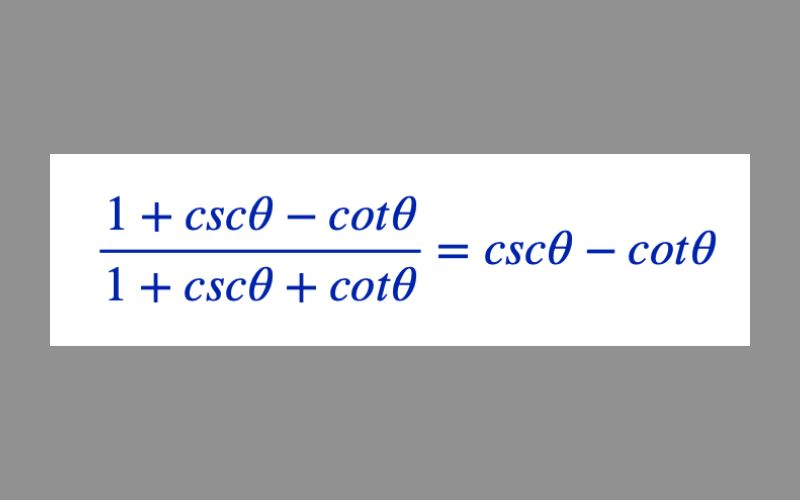
To prove the identity: (1+cscθ−cotθ)/(1+cscθ+cotθ) = cscθ−cotθ
Introduction:
Trigonometry, the branch of mathematics that deals with the relationships between the angles and sides of triangles, often presents us with intriguing identities. One such identity that we’ll unravel in this blog post is:
Let’s embark on a journey of proof, step by step, to demystify this seemingly complex trigonometric expression.
Step 1: Setting the Stage with LHS
We begin with the Left-Hand Side (LHS) of the equation:
Step 2: Leveraging Trigonometric Identities
To simplify the expression, we tap into the rich world of trigonometric identities. Specifically, we employ the identity in the numerator:
Step 3: Factoring the Numerator
The expression is now ready for some algebraic finesse. We factor the numerator using the identity
Step 4: Taking Common Term Out
A key move in trigonometric proofs is often taking common factors. Here, we skillfully extract from the numerator:
Step 5: Cancelling the Common Factor
With a common factor identified, we simplify further by canceling it out from both the numerator and denominator:
= RHS
If you’d like personalized assistance with trigonometry or other math topics, consider signing up for tutoring.